Why Stage Inspections Matter in Brisbane | Real Pre-Plaster Inspection Example
Real Brisbane pre-plaster inspection example showing multiple cut wall studs discovered before plasterboard installation. Learn why stage inspections matter throughout the build process.
4/25/20262 min read
Why Stage Inspections Matter in Brisbane | Real Pre-Plaster Inspection Example
If you're building a new home in Brisbane, it's easy to assume that once the frame has been signed off, everything behind the walls is good to go.
Unfortunately, that's not always the case.
Building work continues long after the frame stage inspection has been completed. Electricians, plumbers, air-conditioning installers and carpenters all return to site to complete their work before plasterboard is installed.
And sometimes, issues can arise after the frame has already been approved.
This week's inspection is a perfect example.
Real Brisbane Inspection Example
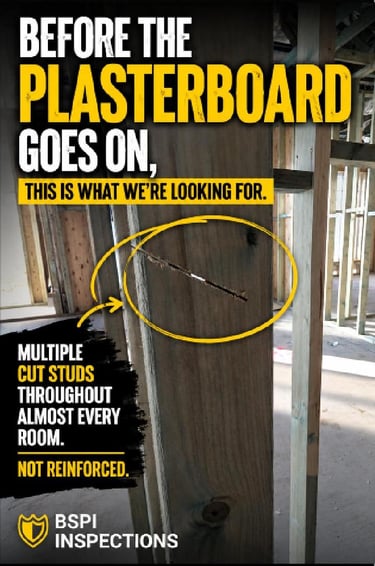
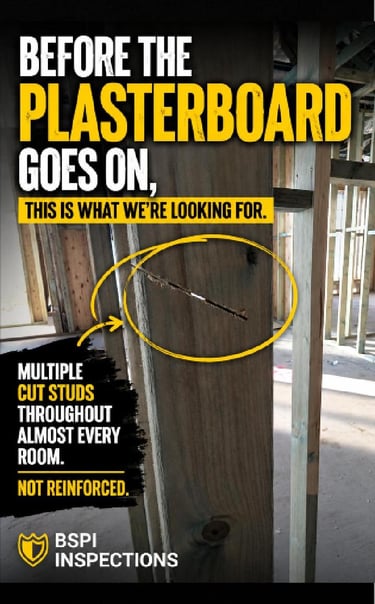
During a recent pre-plaster inspection in Brisbane, we found multiple wall studs that had been cut throughout almost every room of the house.
The studs appeared to have been cut during frame straightening works after the frame stage had already been completed.
While straightening walls is a normal part of the construction process, the cut studs had not been adequately reinforced.
The important thing to understand is that the frame had previously been signed off when it was structurally sound.
The issue was identified later during the construction process, highlighting why a single inspection at frame stage is not always enough.
Why This Matters
Once plasterboard is installed, defects like these disappear behind the finished walls.
The homeowner will never see the framing again without removing plasterboard.
That's why the pre-plaster stage is one of the most important opportunities to identify issues before they become hidden from view.
A defect that is simple to rectify before plasterboard can become significantly more difficult and expensive to investigate once the home is complete.
What Is a Pre-Plaster Inspection?
A pre-plaster inspection is typically carried out after the rough-in trades have completed their work but before insulation and plasterboard are installed.
This stage allows an independent building inspector to assess:
Wall and ceiling framing
Frame straightness and alignment
Roof framing
Structural connections
Bracing and support elements
Window and door installation
Sarking and moisture barriers
Rough-in trade penetrations
Waterproofing preparation
Most importantly, it provides one final opportunity to inspect areas that will soon be permanently covered.
A Lot Can Happen Between Frame Stage and Plasterboard
One of the biggest misconceptions in residential construction is that once the frame has passed inspection, the framing never changes.
In reality, work continues on site every day.
Additional framing may be installed.
Walls may be straightened.
Services may be run through framing members.
Structural elements may be altered.
Most trades do excellent work, but mistakes can happen on any construction site.
That's why independent stage inspections provide another set of eyes before critical components are covered.
Why Brisbane Homeowners Choose Stage Inspections
At BSPI Inspections, we regularly identify defects during construction that would be extremely difficult to detect after handover.
The goal isn't to create conflict with builders.
The goal is simple:
Identify issues early, while they are still easy to access and rectify.
A quality stage inspection can provide peace of mind that your new home is progressing as intended before each stage is covered by the next.
Building a New Home in Brisbane?
BSPI Inspections provides independent stage inspections throughout the Brisbane region, including:
Pre-Slab Inspections
Frame Stage Inspections
Pre-Plaster Inspections
Waterproofing Inspections
Fixing Stage Inspections
Practical Completion Inspections (PCI)
If you're building a new home and want an independent assessment before the next stage is covered, contact BSPI Inspections for a free quote.
Because once plasterboard goes on, what's behind the walls becomes a lot harder to inspect.
If there’s a specific stage you’d like to learn more about, click the link below to explore that section on our blog.